
Introduction
Mental Health in Education supports better concentration, emotional balance, classroom participation, and long-term academic growth. When schools, teachers, and parents take student well-being seriously, learners are more likely to stay motivated and develop a positive attitude toward learning. Education has always been seen as the foundation for success. From early childhood, students are told that if they study hard, pass exams, and achieve good grades, they will secure a better future.
Mental Health in Education helps students build confidence, manage pressure, and stay motivated throughout their learning journey. But there is a silent factor that determines whether all that effort leads to success or frustration. That factor is mental health.
In 2026, the educational environment is more demanding than ever. Students are no longer dealing with just textbooks and classrooms. They are navigating a complex world filled with:
- Academic pressure to perform at increasingly higher levels
- Financial concerns about tuition, survival, and future stability
- Social expectations from family, peers, and society
- Constant exposure to social media comparison
- The challenges of online learning and digital distractions.
These pressures do not just affect performance-they affect the mind.
And when the mind is overwhelmed, learning becomes difficult, no matter how intelligent or hardworking a student may be. A student can spend hours reading, attending classes, or watching online lessons, but still struggle to focus if the mind is stressed.
Many students appear fine on the outside, but internally they are struggling with:
- Anxiety and stress
- Burnout and exhaustion
- Loss of motivation
- Low self-confidence
- Mental fatigue.
Education without mental well-being is incomplete. A strong mind is the foundation for meaningful learning.
This is why mental health is no longer something that can be ignored. It is not optional-it is essential.
In this guide, we will explore:
- What mental health really means in education
- Why it directly affects learning outcomes
- The hidden challenges students face
- Practical strategies to improve mental well-being
- How students and educators can create better environments.
Why Mental Health in Education Matters (In the Context of Education)
Mental health is more than just the absence of illness. It is the state of your mind-how you think, feel, and respond to challenges.
In education, mental health affects:
- Your ability to concentrate
- Your ability to understand information
- Your motivation to study
- Your emotional stability during challenges.
Mental Health Includes:
- Emotional balance
- Stress management
- Self-confidence
- Focus and clarity
- Resilience.
When students have good mental balance, they are more likely to learn with confidence, handle pressure better, and recover from setbacks.

“A distracted mind cannot absorb knowledge, and a stressed mind cannot apply it.”
Why Mental Health Is Critical in Education
Mental Health in Education is important because emotional wellness affects how students focus, remember information, solve problems, and interact with teachers and classmates. Let’s go deeper.
Many students believe success comes from studying harder. But studying harder with a stressed mind often produces poor results.
1. Mental Health Affects Focus
When your mind is overwhelmed:
- You get distracted easily
- You struggle to stay engaged
- You waste study time.
A calm mind helps students stay present and understand lessons better.
2. It Affects Memory
Stress interferes with how the brain processes and stores information.
Result:
- You forget quickly
- You struggle to recall during exams.
This is why some students study hard but still feel blank during tests.
3. It Affects Motivation
A mentally exhausted student often feels:
- Lazy
- Uninterested
- Unmotivated.
But the issue is not laziness-it is mental fatigue.
4. It Affects Confidence
Poor mental health leads to:
- Self-doubt
- Fear of failure
- Avoidance of challenges.
When students lose confidence, they may stop trying, even when they have real potential.
“Confidence grows in a healthy mind-and disappears in a stressed one.”
Common Mental Health Challenges in Students
Mental Health in Education affects how students think, learn, behave, communicate, and respond to challenges. When students receive emotional support, they are more likely to concentrate, participate in class, complete assignments, and develop a positive attitude toward learning. Students today face multiple hidden struggles. When schools focus on Mental Health in Education, students are more likely to ask for help before stress, anxiety, or discouragement worsens.
1. Academic Pressure
Students are expected to:
- Perform consistently
- Meet high expectations
- Compete with others.
This creates constant stress.
2. Social Comparison
Social media creates unrealistic expectations.
Students compare:
- Grades
- Lifestyle
- Achievements.
This can make students feel behind, even when they are making progress.
3. Financial Stress
Many students worry about:
- Tuition
- Living expenses
- Supporting family.
Financial pressure can affect concentration and emotional stability.
4. Fear of Failure
Fear stops students from:
- Trying new things
- Taking risks
- Asking questions.
Instead of seeing mistakes as part of learning, they may begin to see mistakes as proof that they are not good enough.

“Comparison steals confidence, and pressure steals peace.”
Mental Health and Online Learning
Online learning has increased flexibility-but also introduced new challenges.
Challenges Include:
- Isolation
- Lack of supervision
- Increased distractions
- Self-discipline pressure.
Why Mental Strength Is Important
Online learning requires:
- Self-control
- Focus
- Internal motivation.
Without mental balance, students may start online courses but struggle to complete them.
Signs of Poor Mental Health in Students
Recognizing the signs early is important.
Common Signs
- Lack of interest in studies
- Constant tiredness
- Poor concentration
- Anxiety or worry
- Withdrawal from others.
Other signs may include avoiding assignments, sleeping too much or too little, and feeling overwhelmed for long periods.
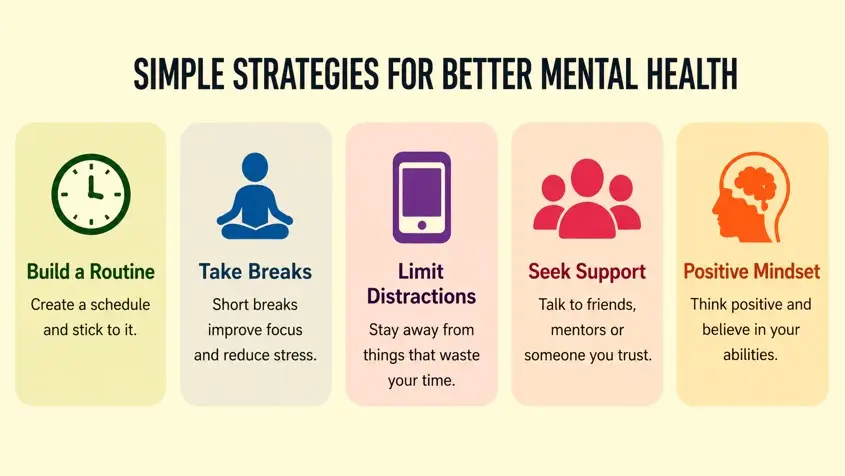
Simple Ways to Support Mental Health in Education
Now let’s focus on solutions.
1. Build a Healthy Routine
Routine reduces stress and creates structure.
A Good Routine Includes
- Study time
- Break time
- Sleep time.
A healthy routine helps students feel more organized and in control.
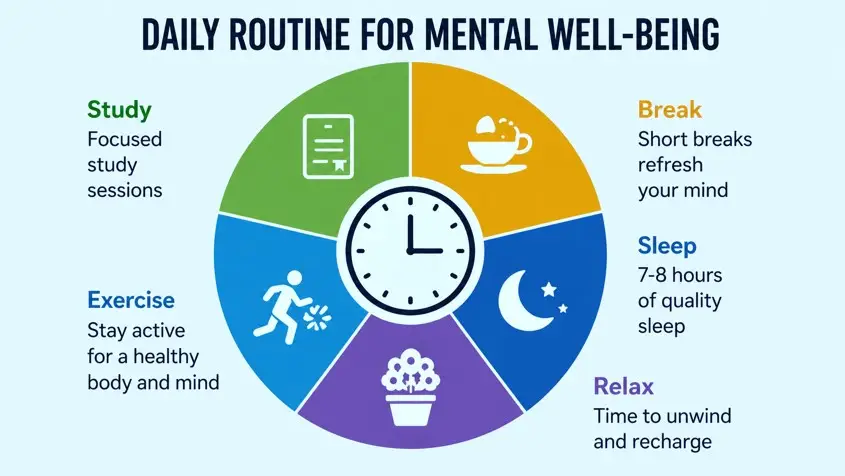
“A structured life creates a stable mind.”
2. Take Breaks and Avoid Burnout
Studying non-stop reduces productivity.
Best Method
Use the Pomodoro Technique:
- 25 minutes study
- 5-minute break.
Short breaks help refresh the mind and improve focus.
3. Limit Social Media
Too much exposure leads to:
- Distraction
- Comparison
- Anxiety.
Students can reduce this by turning off unnecessary notifications and avoiding social media during study time.

4. Build a Support System
You are not meant to handle everything alone.
Talking to a trusted friend, parent, teacher, mentor, or counselor can reduce emotional pressure and help students feel supported.

5. Develop a Positive Mindset
Your mindset shapes your results.
Mindset Practices
- Focus on progress
- Celebrate small wins
- Avoid comparison.
A positive mindset does not mean ignoring problems. It means believing that growth is possible, even when learning feels difficult.
“Your mindset can either limit you or lift you.”
Role of Educators and Institutions
Mental health is not only the student’s responsibility.
Educators Should:
- Encourage open communication
- Reduce unnecessary pressure
- Support struggling students.
When students feel safe, respected, and supported, they are more likely to participate, ask questions, and perform better.
Long-Term Benefits of Good Mental Health
Students who manage their mental health experience:
- Better academic performance
- Strong confidence
- Better decision-making
- Long-term success.
Good mental health also helps students build stronger relationships, handle challenges better, and prepare for life beyond school.
Real-Life Scenario
Student A studies 10 hours daily but is stressed and anxious.
Student B studies 4 hours daily with a calm and focused mind.
- Who performs better?
- Most times, it is Student B.
- Because quality of mind matters more than quantity of time.
Summary
Mental health affects:
- Focus
- Learning
- Confidence
- Results.
To improve it:
- Build routines
- Take breaks
- Reduce distractions
- Seek support
- Maintain a positive mindset.
Helpful Mental Health Resources
For more trusted information about student well-being and mental health support, you can read resources from World Health Organization, UNICEF, and UNESCO.
You can also explore more practical learning and personal growth articles on the Benfilo Tech Hub Blog.
Conclusion
Mental Health in Education should remain a major part of student success because a healthy mind supports better learning, stronger confidence, and positive growth. Mental Health in Education should be treated as a core part of student success, not a separate issue. It is about thinking clearly, staying balanced, and maintaining a healthy mind. When your mind is healthy, your potential becomes limitless.
Interactive Section
Let’s talk:
- What affects your focus the most?
- How do you manage stress while studying?
- Do you prefer studying alone or with others?
Drop your answer in the comments!
At Benfilo Tech Hub, we believe in:
- Skills + Mindset + Growth
Explore tools and training to improve your future-mentally and financially.